Decide who signs before you sign
Ask each Sugar Hill installer whose names will go on the City's permit paperwork. The answer tells you who will be responsible when something is late, missing or leaking.
The City's General Permit Application says every structure must have a general contractor and "Affidavits Completed for Each Trade," with copies of a business license and a contractor license for each trade. A general contractor holds the permit and answers to the City for the whole job. A trade subcontractor, here the electrical contractor, signs for one part. The same form has a line for the Electrical Co. Name and one for the Power Company, and your signature on it acknowledges permission from property owners and HOAs.
The City's 2025 Sub-Contractor Affidavit is where the electrical contractor certifies responsibility for the electrical work. It must reach the Planning Office before work starts and be there at least 24 hours before anyone requests an inspection. It asks for business and state license numbers, and one form is needed per permit.
Georgia has no separate solar license. The wiring on a rooftop array needs a licensed electrical contractor, so the state license number on that affidavit is the one to check with the Georgia Secretary of State before you sign.
That leaves three names to settle before anyone drills a hole: the general contractor, the electrical contractor, and the power company on your electric bill. A quote that leaves any of them "to be determined" has hand-offs with no owner.
Settle the roof before panels go on
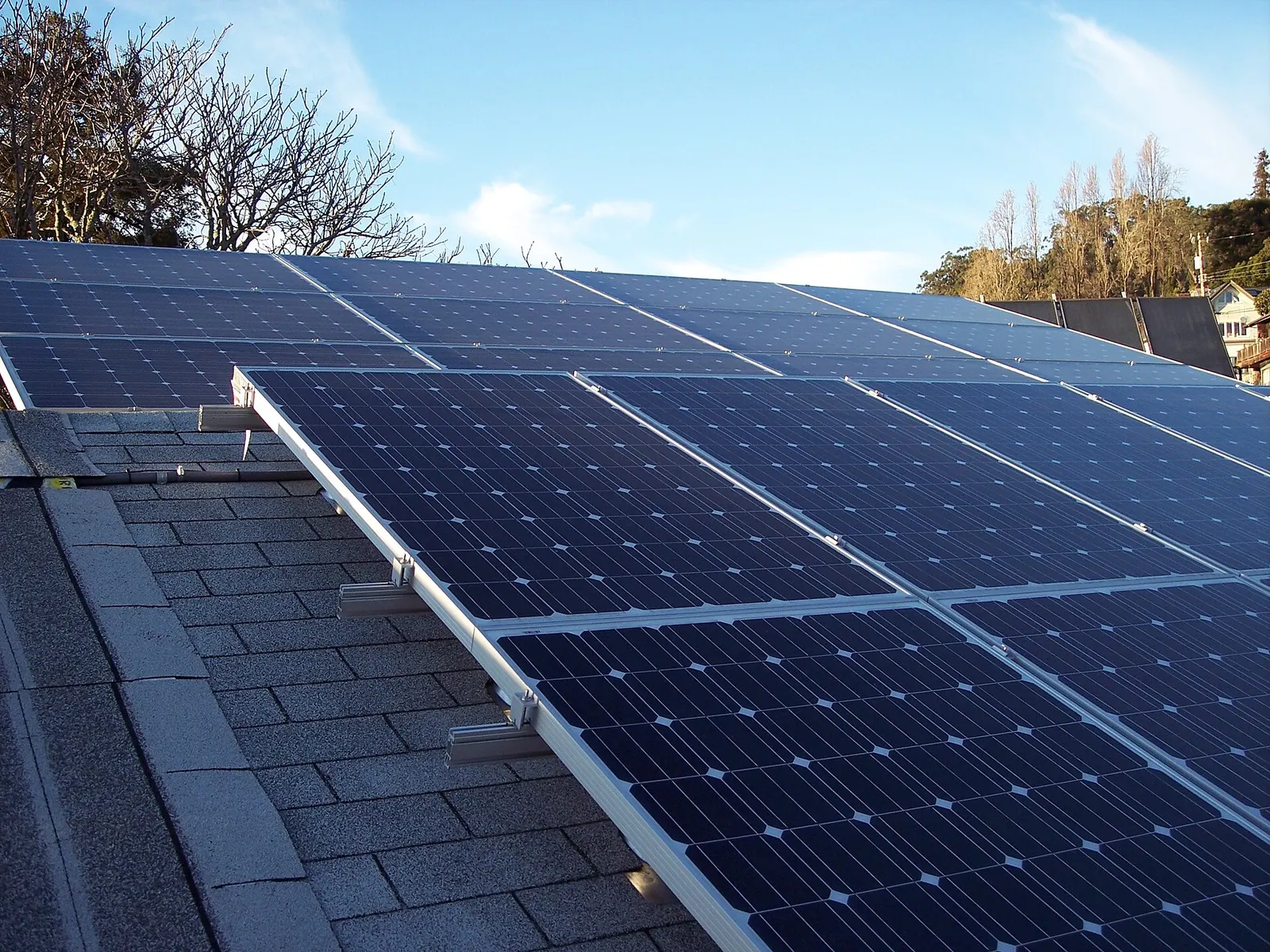
On a shingle roof, a flashed mount means a penetration: a hole drilled through the shingles and roof deck so a lag bolt can reach a rafter. Flashing is the metal or composite piece that slides under the shingles around that hole and sheds water past it. Underlayment is the water-resistant layer under the shingles that catches what they miss. If any of the three is done badly, a leak can show up months later under a panel, where nobody sees it.
Sugar Hill's paperwork won't settle this for you. The City's affidavit names trades for electrical, plumbing and heating-air work, so it records who answers for the wiring. It has no line for roofing, which means no City form records who answers for a leak at a mount. Your contract has to name that party.
If the shingles will need replacing while the panels are up, the panels come off and go back on, and someone pays for that. Ask for three paths priced separately:
- Install on the current roof if it has enough life left.
- Repair the area under the panels first if the problems are local.
- Replace first, then install if the roof is near the end of its life.
Then ask who flashes every mount, who patches the underlayment, who comes back if a mount leaks, and whether a future removal and reinstall is priced or marked "not included." When a roofer and a solar company are hired separately, each can assume the other owns the flashing. The proposed service exists to put that answer on paper before work starts.
Timing matters on the replace-first path. Sugar Hill's application says a permit becomes invalid if work is suspended for six months. If the solar work could start more than six months after the roof is finished, ask how the installer will keep the permit alive, or when they plan to file it.
Sugar Hill's paperwork, in order
Start with the parcel, not the mailing address. Sugar Hill Building Services handles permits and inspections inside city limits. A Sugar Hill mailing address can sit outside them; for an unincorporated parcel, Gwinnett County issues permits instead.
Inside city limits, the steps run like this:
| Step | Who signs or acts | When | What it holds up |
|---|---|---|---|
| Confirm the parcel is inside city limits | Installer, with your address | Before the quote is final | Which office gets the application |
| HOA approval, if you have an HOA | You, with the association | Before you sign the application | Your signature acknowledges HOA permission |
| General Permit Application | General contractor; you sign the acknowledgment | Before work starts | Permit issue, and so all work |
| Sub-Contractor Affidavit (electrical) | The electrical contractor | Before work, and at least 24 hours before an inspection request | The inspection request |
| Inspection request | The permit holder, through the City's online form with the permit number | By 2 p.m. for the next business day, if the information is accurate and the workload allows | The local inspection report the utility asks for |
| Utility application and witness test | You sign; you or the installer may submit it | After the City inspection | Permission to Operate |
On a complete application, the City says initial review happens within 30 days unless it notifies you otherwise. Build that month into any schedule an installer shows you.
Building Services and the City's forms page list no rooftop-solar checklist. They list items for residential additions and single-family homes and say to contact Planning and Development for a submittal checklist. That does not mean nothing extra is required. Ask your installer to get the submittal list in writing and attach it to the quote, so you both know whether a roof structure letter or anything else is expected. Get HOA approval in writing too, before your signature tells the City you have it.
If you're downtown: design review may come first
The City's Zoning Ordinance says that in the Town Center Overlay and the Central Business District (CBD) overlay, no material change in exterior appearance may happen until the Mayor and Council approve design review. You can file the permit application at the same time, but no permit is issued before approval. In the CBD overlay, solar collectors must sit at the rear of the building or out of public street view.
The ordinance does not say whether a rooftop array on an existing house counts as a material change, so ask Planning before the design is final. Design review has no application fee, and submittals are due the first Friday of each month. On the City's 2027 calendar, a December 4, 2026 submittal reaches Council on February 8, 2027, so the earliest permit date is about two months after you submit.
After the City inspection: the power company's approval
Passing the City inspection does not let you switch the system on. The utility's approval comes next, and it depends on the City's paperwork.
Georgia Power's rooftop solar FAQ lays out its route. Applications go through PowerClerk, Georgia Power's online system. The installer or the customer may apply, but the agreement is between Georgia Power and you, so it needs your signature. It asks for your account number, a one-line drawing (a simple diagram of how panels, inverter, disconnect and meter connect), panel and inverter specifications, installer information and the local inspection report, if applicable. In Sugar Hill, that report comes from the City inspection, which is why a late affidavit delays the utility step too.
Next comes a witness test, a utility visit to check the installed system. The meter is reprogrammed and Georgia Power emails a Permission to Operate (PTO) letter, its written go-ahead, to you and the installer with the Interconnection Agreement. Keep it. Georgia Power says PTO covers only the original customer, equipment, AC nameplate rating and point of interconnection; change any of them and a new application is needed.
If your bill says Jackson EMC, Jackson requires an interconnection agreement before the system operates. If it says Sawnee EMC, ask Sawnee for its current steps in writing.
Read the power company off your electric bill
The City of Sugar Hill runs a gas utility, not an electric one. Don't let anyone build a solar estimate from the City bill.
In Georgia, your electric supplier is fixed by your address. The City's inter-agency route sheet, used for development review, lists Georgia Power and Sawnee Electric as the electrical providers it deals with. That shows both serve inside Sugar Hill, not which one serves your house. Jackson EMC serves parts of Gwinnett County, but its presence inside Sugar Hill is not confirmed. Read the name on your electric bill and hand that bill to every installer.
The name matters because the three pay very different amounts for power you send to the grid. Georgia Power uses instantaneous netting: solar power your home uses as it is produced reduces what you buy, and only the surplus flowing out at that moment earns an export credit. The EMCs also credit excess energy at rates they set. Either way, the credit is the utility's rate, not the price you pay per kWh. Compare each credit with the per-kWh price on your own bill; the wider the gap, the more a kWh you use yourself is worth than one you export.
| Utility (as printed on your bill) | 2026 export credit | Monthly solar charge | Residential size limit | Credit for 3,000 kWh exported in a year (Illustrative calculation) |
|---|---|---|---|---|
| Georgia Power | 3.2188¢ avoided cost + 4¢ adder = 7.22¢ per kWh | None stated; basic service charge billed every month | 10 kW AC | 3,000 × $0.0722 = $216.60 |
| Sawnee EMC | 3.79¢ per kWh since May 1, 2026 (reported; confirm with Sawnee) | Not confirmed | Not confirmed | 3,000 × $0.0379 = $113.70 |
| Jackson EMC (only if your bill says so) | 4.32¢ per kWh | $10 a month | 10 kW | $129.60 in credits − $120 in charges = $9.60 |
Assumptions: 3,000 kWh exported is an example, not a forecast for your home; 2026 rates held flat for the year; a system you own. On Jackson EMC, the $120 a year in charges equals the credit on about 2,778 exported kWh.
Georgia Power's FAQ gives the 2026 rate and the 4¢ adder from the 2022 rate case, says instantaneous netting is open first come, first served until a capacity limit is reached, and bills an interconnection fee after completion. Its export rate is reset each year. Jackson EMC's net metering rider sets its terms and pays any credit balance by check each December. Sawnee EMC's 3.79¢, up from 3.48¢ on May 1, 2026, is as reported by EcoGen's Georgia solar incentives page in October 2026. This page could not confirm it with Sawnee directly, so ask Sawnee for its current rate before you sign.
So an export-heavy design loses more value on Sawnee or Jackson than on Georgia Power. Size the system to your home's own daytime use, and ask each installer which utility, which year's rate and what export share their estimate assumes.
Take the roof line out, then compare per watt
A roof-first quote may carry a roof line. That line is legitimate. It just isn't a solar cost, and leaving it in makes a fair solar price look high.
Price per watt ($/W) is the solar price divided by system watts. Use the DC rating, the panels' total nameplate (7.2 kW DC is 7,200 watts), not the inverter's AC output.
The yardstick is $2.78 per watt (State benchmark) from the EcoGen Solar Cost Index, September 2026 edition, prices as of September 25, 2026. EcoGen's Georgia cost page puts a typical 9.21 kW system at about $25,604, host-owned, before incentives. EcoGen's methodology calls it a modeled state benchmark, not a quote, and does not say whether the watts are DC or AC. Treat it as a rough check; nobody owes you that price.
- Take the quote's total.
- Subtract the roof replacement or repair line, and any battery or other optional line.
- Divide what is left by the DC watts on the quote.
- Compare the result with $2.78/W.
A result above the benchmark doesn't prove overcharging. It gives you a question to ask. A main-panel upgrade or a costlier equipment choice can explain a gap; ask the installer which line does.
One number should not appear on a 2026 quote for a system you buy: a 30% federal credit. The IRS says the Section 25D credit is not allowed for expenditures after December 31, 2025, and the expenditure is made when installation is completed. A home system you own that is completed in 2026 gets no federal residential credit. If a quote shows an "after tax credit" price for an owned system, ask for the full price; that is what you would pay.
One plan vs two trades: a Sugar Hill example
Illustrative example. A homeowner inside Sugar Hill city limits has a shingle roof about 20 years old and wants a 7.2 kW DC array. All dollar figures are illustrative, not quotes or prices from Maravegias and Sons.
Proposal A, two trades hired separately. A roofer replaces the shingles under its own contract. Weeks later a solar company files its own permit application. Nobody is named for flashing at the mounts. The electrical contractor has not filed the City's Sub-Contractor Affidavit, so when the array is ready, the inspection cannot be requested; the affidavit must be on file 24 hours first. The Georgia Power application waits too, because it asks for the local inspection report.
Proposal B, one coordinated plan. One permit application lists the general contractor, the electrical company and the power company from the homeowner's bill. The affidavit is filed with the permit, well before any inspection request. The plan names who installs the flashing at each mount and who answers a leak there.
Price check (Illustrative calculation). Proposal B totals $27,400, including a $5,200 roof line. Solar only: $27,400 − $5,200 = $22,200. Divided by 7,200 watts, that is $3.08/W against EcoGen's $2.78/W State benchmark, about $0.30/W or 11% above. Without removing the roof line, the same quote reads $3.81/W, a false alarm. At the benchmark, 7.2 kW would come to about $20,016 before roof work.
Proposal A's problems don't show in its price; they sit in the gaps between contracts. Proposal B's price still needs explaining: $0.30/W above the benchmark is a fair question to put in writing.
On your own quotes, check that each names all three parties from the City form, says when the affidavit will be filed, and names a flashing owner. Strip the roof line from every total before dividing by DC watts, then ask any installer above the benchmark what explains the gap.
What the proposed service would put in writing
Proposed service. Maravegias and Sons Roofing and Solar proposes a roof-and-solar service that starts with the roof, then plans the mounts and the electrical and utility path in one written plan. Coverage for Sugar Hill is proposed and not yet confirmed. You can read how the proposed roof-first plan works; here is what it would mean on a Sugar Hill job.
You'd send an electric bill, 12 months of usage, the roof's age or last invoice, any roof warranty, HOA covenants and the parcel address. The proposed service would turn those into seven documents:
- Roof condition report. Attic and deck check, shingle and underlayment age, existing flashing, rafter spacing, photos per roof plane, and a repair-or-replace-first recommendation.
- Roof-first decision sheet. Install now, repair first or replace first, each with its own line items and, for replace-first, dates that keep the permit inside the City's six-month rule.
- Penetration and flashing responsibility sheet. Mount type (for example, flashed lag-bolt mounts or a rail-less system), penetration count and locations, and the named party for flashing, underlayment, any future leak at a mount and a future removal and reinstall.
- Electrical scope. A marked layout with DC and AC ratings, inverter type, a main-panel check, and the licensed electrical contractor whose affidavit goes on the City permit, named with a Georgia license number.
- Permit plan. City or Gwinnett County confirmed from the parcel, the applicant, the Planning and Development submittal list, any downtown design review, and the inspection steps.
- Utility handoff sheet. The power company named on the City form and your bill, its program, the export rate and year used in the savings estimate, and who submits the application.
- Closeout pack. Permit number, City inspection result, PTO letter and as-built photos of every penetration.
A battery could be quoted as a separate optional line; it is not the point of this plan.
Questions to ask before you sign in Sugar Hill
Take these to every installer and use the quote checklist on this site to collect the answers.
- Is my parcel inside Sugar Hill city limits, and how did you confirm it?
- Is it in the Town Center or CBD overlay, and have you asked Planning whether my array needs design review?
- Who is the general contractor on the General Permit Application?
- Which electrical contractor signs the Sub-Contractor Affidavit, and what are their business and state license numbers?
- When will the affidavit be filed, and who requests inspections with the permit number?
- Do you have the Planning and Development submittal list for a rooftop array in writing?
- Will you wait for written HOA approval before the application goes in?
- Will the roof outlast the panels? If not, which roof path are you pricing, and how will the permit stay valid between jobs?
- Who installs the flashing at each mount, and who answers a leak there?
- Which utility did you read off my bill, which year's export rate did you use, and what export share does the estimate assume?
- What is the solar-only price per DC watt with roof and battery lines removed?
- Who submits the utility application and sends it the City's inspection report?
- Does the quote assume any federal tax credit for a system I own?
What should come back is a quote with roof, solar, electrical and permit or utility lines separated, and all three names filled in. If an installer can't answer questions 3 to 5, the hand-offs in the paperwork table have no owner yet.
Short answers for Sugar Hill edge cases
My address says Sugar Hill, but I may be outside city limits. Then, for an unincorporated parcel, Gwinnett County issues permits, not Sugar Hill Building Services, and the City's affidavit and inspection steps above may not apply. Confirm from the parcel and ask which office's requirements the quote is built on.
My electric bill says Jackson EMC. Use Jackson's rates from the table and sign its interconnection agreement before the system operates. Jackson's rooftop solar page also asks whether your roof is in good condition and whether deed or HOA restrictions apply, so have both answers ready.
I'm downtown. Ask Planning whether your array triggers design review before you finalize the design. If it does, the monthly submittal deadline and the Council calendar set your earliest permit date.